MiniMax says its new M3.1 Flash AI costs 70% less for agent tasks
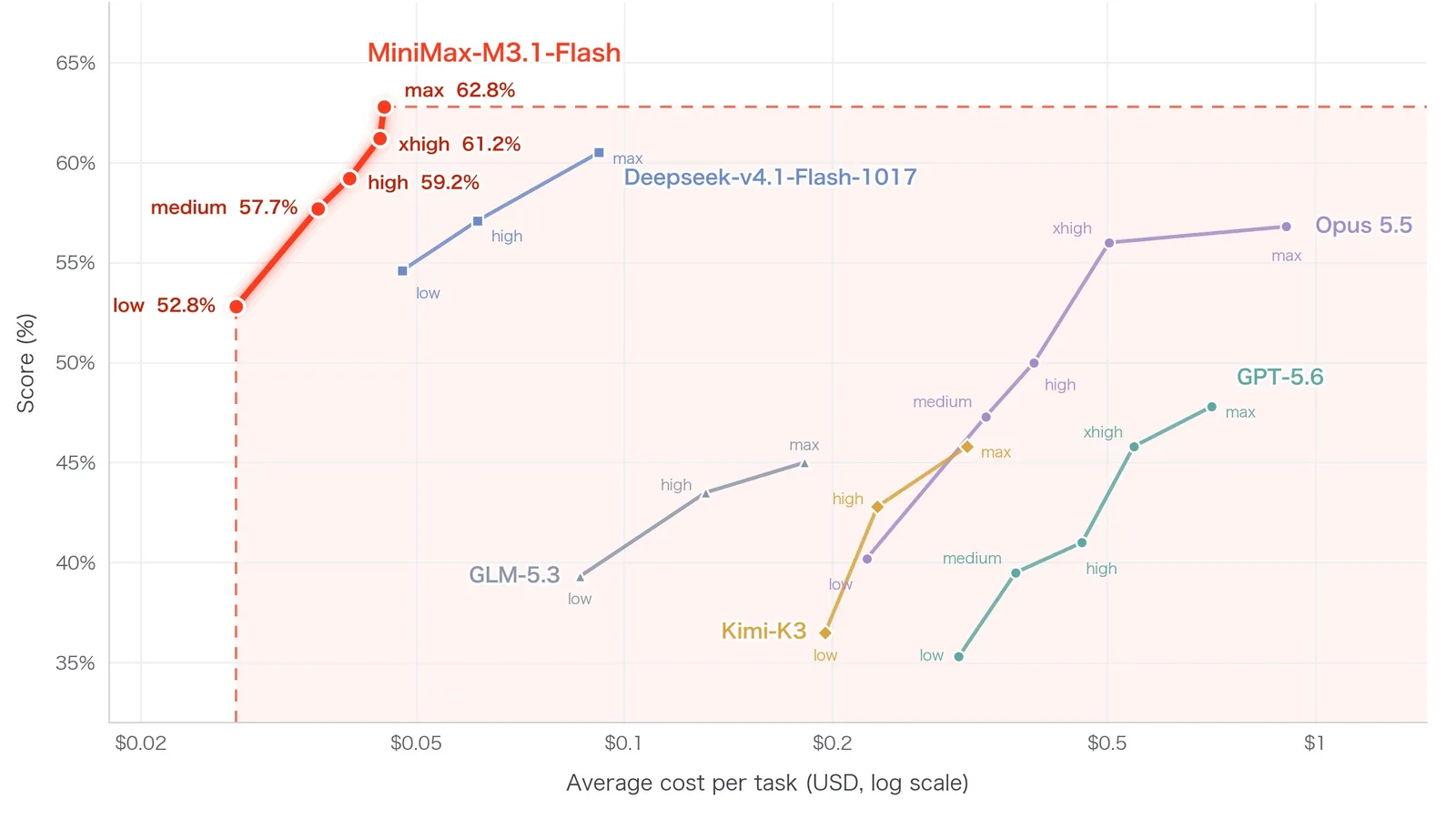
On 19 October 2026, the Chinese AI company MiniMax released M3.1 Flash, a model built for agent tasks, coding and computer use. MiniMax says online inference is nearly three times faster and agent tasks cost 70% less than its predecessor. It costs $0.15 per million input tokens and $0.60 per million output tokens.
The short version
- 01MiniMax released M3.1 Flash on 19 October 2026 through its API, M Plan and MiniMax Code.
- 02MiniMax says online inference is nearly three times faster and agent costs 70% lower than its predecessor.
- 03Price: $0.15 per million input tokens, $0.60 per million output tokens.
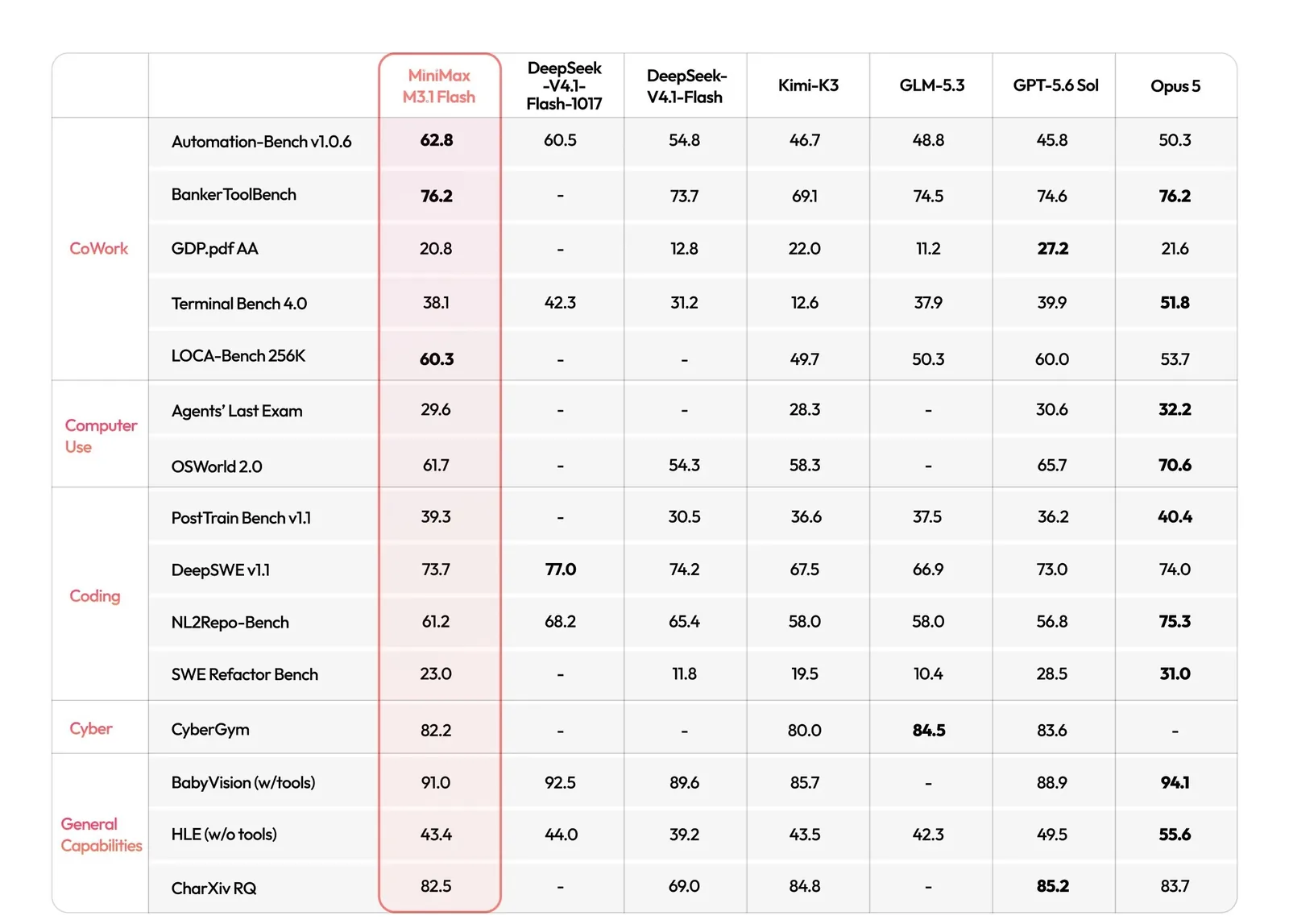
- 04MiniMax reports 73.7% on DeepSWE v1.1 and 61.7 on OSWorld V2. These are its own results.
- 05Model weights will be released later.
At a glance
| Released | 19 October 2026 |
|---|---|
| Company | MiniMax |
| Input price | $0.15 per million tokens |
| Output price | $0.60 per million tokens |
| Speed | Output of 200+ tokens a second, MiniMax says |
| Available in | MiniMax API, M Plan, MiniMax Code |
| Weights | To be released later |
| Status | Confirmed |
What is MiniMax M3.1 Flash?
In a post on 19 October 2026, MiniMax said it is rolling out M3.1 Flash, a next-generation Flash model. It says the model brings a "generational leap" in agentic tasks, coding, computer use and cybersecurity.
MiniMax says an early version, called Space Bunny, processed more than 200 trillion tokens while operating anonymously.
How much does MiniMax M3.1 Flash cost?
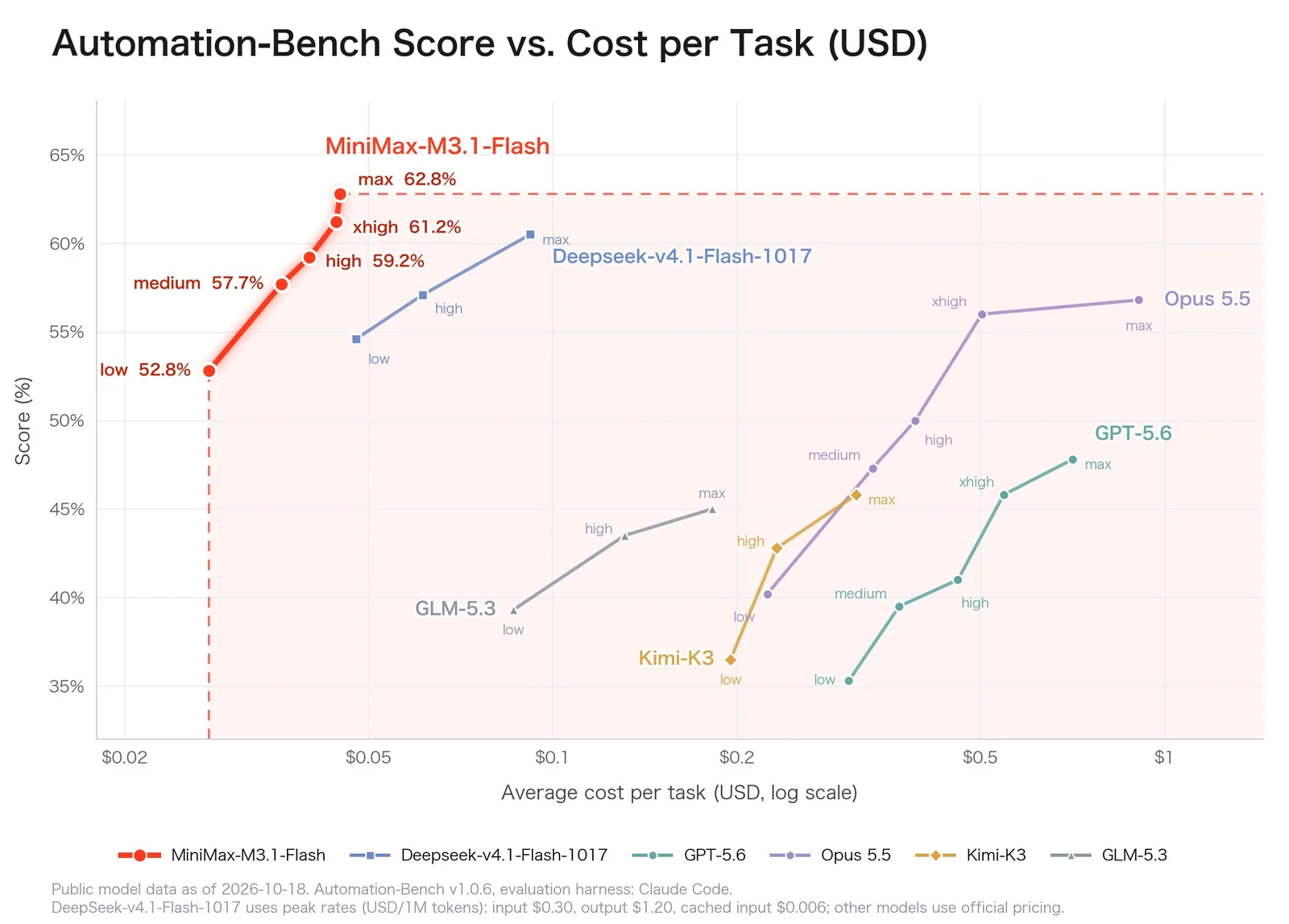
MiniMax lists flat pricing per million tokens: $0.15 for input, $0.60 for output and $0.015 for cached input. It says the overall cost of agent tasks is 70% lower than its predecessor.
It also says output speeds can reach 200+ tokens a second, and that online inference is nearly three times faster.
How well does it score?
MiniMax reports 73.7% on DeepSWE v1.1, a coding test, 61.7 on OSWorld V2, which measures computer use, and 82% on CyberGym, a vulnerability test. It says it ranks first among Chinese models on OSWorld V2 and Agents' Last Exam.
These results come from MiniMax's own post, not from outside testers.
Where can you use it?
M3.1 Flash is available through the MiniMax API, M Plan and MiniMax Code. MiniMax says the model weights will be released later, and that a Pro model, which pushes the boundaries of intelligence, will also arrive later.
Why does it matter?
Agents make many model calls, so price per task matters to developers. If MiniMax's numbers hold up in independent tests, a model at this price makes long-running agents cheaper to run.
What's next?
Watch for the weights, the Pro model, and outside benchmarks that test MiniMax's claims.
Questions people ask
When was M3.1 Flash released?
On 19 October 2026.
How much does it cost?
$0.15 per million input tokens, $0.60 per million output tokens and $0.015 per million cached input tokens.
Is it faster than the previous model?
MiniMax says online inference is nearly three times faster.
Can I download it?
Not yet. MiniMax says the weights will be released later. It is available through the MiniMax API, M Plan and MiniMax Code.
Are the scores independent?
No. The scores in MiniMax's post are its own.
Sources
Why "Confirmed"? We label a story "Confirmed" when the company or government announced it itself. Spotted an error? Email hello@openloopnews.com and we will correct it.