Claude traced the origin of NIST's elliptic curve seeds
On 16 October 2026, Anthropic said its Claude model worked out where the seeds of NIST's elliptic curves, used in ECDSA, came from. In under half an hour, it found they were made by a 1990s random number generator started with a timestamp, not by a hash of a phrase. Anthropic says this is not an attack or a weakness.

The short version
- 01Anthropic said on 16 October 2026 that Claude traced the seeds of five NIST prime curves.
- 02The seeds came from the C library's lrand48 random number generator, started with a Unix timestamp from 1997 or 1998.
- 03Claude did it in under half an hour, Anthropic says.
- 04Anthropic says it is not a cryptographic break, a new attack or a weakness in the curves.
- 05Some questions stay open, including how four base points and one binary seed were made.
At a glance
| Announced | 16 October 2026 |
|---|---|
| By | Anthropic's Frontier Red Team |
| Standard | NIST elliptic curves used in ECDSA |
| Time Claude took | Under half an hour |
| Seeds explained | P-192, P-224, P-256, P-384 and P-521 |
| Impact | No action needed, Anthropic says |
| Bounty | $36,864, donated to the Internet Security Research Group |
| Status | Confirmed |
What did Anthropic find?
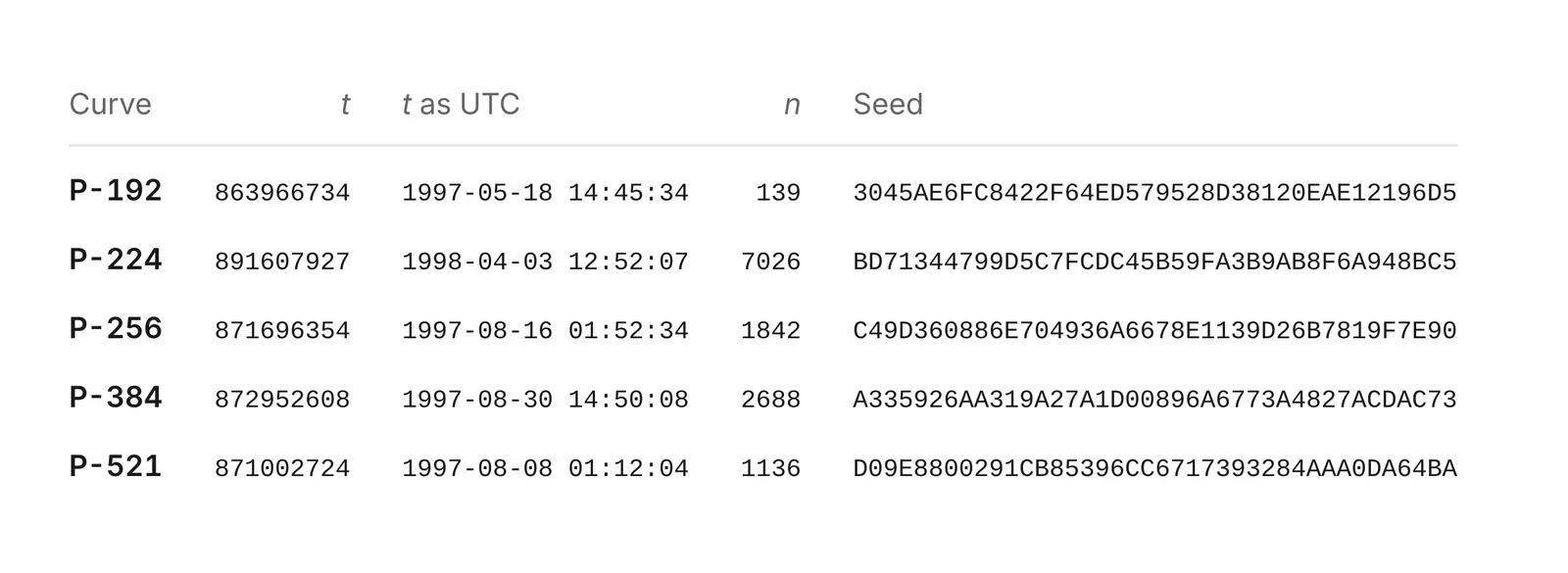
Anthropic says Claude found where the seeds of the NIST P-192, P-224, P-256, P-384 and P-521 curves came from, according to its research post. None of them were the result of a hash. They were the output of the C library's lrand48 random number generator, started with a Unix timestamp.
A Unix timestamp is a clock reading. For the five NIST prime curves, Anthropic says every starting time falls between May 1997 and April 1998.
Why did the seeds matter?
ECDSA is a widely used elliptic curve standard, adopted by NIST in 2000. Its curves come with a published seed, and the NSA supplied them with no explanation. For years, some people suspected a hidden backdoor.
The best-known story was that the seeds came from a hash of a joke phrase, such as 'Give Bob and Jerry a raise'. Anthropic says several of its employees chased that clue without success, and that it turned out to be wrong.
How did Claude do it?
In October 2026, Anthropic says, a curious employee asked an internal research model to work out how the seeds were made, without pointing it at the clue. Claude guessed that a 1990s random number generator was used, and wrote a scanner to test the idea.
It noticed that the top bit was zero in many of the seeds' words, which pointed to lrand48. It then used a standard maths technique to recover the generator's starting state, and stepped back to a timestamp.
Is this a security problem?
No, Anthropic says. In its words: "This is not a cryptographic break, new attack, or weakness in the ECDSA curves." It says the finding makes it more confident the curves were chosen without any backdoors or intentional weaknesses.
Anthropic tells readers there is no action to take, and says most researchers already trusted the curves.
What is still unexplained?
Anthropic could not explain how the base points of P-224, P-256, P-384 and P-521 were chosen, or the seed of the binary curve B-163. It also notes that some other possible curves were skipped in each run, and says it does not know why.
It says the number of skipped curves is small, so it does not think weakened curves were selected.
Why does it matter?
It is a case of an AI model solving a question that researchers had left open for years. It also removes one of the best-known reasons to doubt a standard that protects a lot of software. The work is Anthropic's own, and outside experts have not yet been quoted on it.
What's next?
Anthropic published code to reproduce the seeds. It says the $36,864 bounty for finding them will be donated to the Internet Security Research Group.
Questions people ask
What is ECDSA?
ECDSA is a widely used digital signature standard built on elliptic curve cryptography. NIST adopted it in 2000.
What did Claude find?
Anthropic says the seeds of five NIST prime curves came from the lrand48 random number generator, started with a Unix timestamp.
How long did it take?
Under half an hour, according to Anthropic.
Does this weaken ECDSA?
No. Anthropic says it is not a break, attack or weakness, and that it makes a backdoor much less plausible.
What is still unknown?
How four base points and the B-163 seed were made, and why some candidate curves were skipped.
Sources
Why "Confirmed"? We label a story "Confirmed" when the company or government announced it itself. Spotted an error? Email hello@openloopnews.com and we will correct it.