US limits remote use of AI chips by Chinese firms, adds licences for Malaysia
The US Commerce Department has issued an interim final rule on remote access to advanced AI chips. Data centres that supply large amounts of computing power to companies headquartered in China or other restricted countries need a licence. Exports of advanced chips to Indonesia, Malaysia, Singapore, Thailand and Brazil now also need one. It takes effect when published in the Federal Register.

The short version
- 01The rule targets data centres anywhere that give remote access to big amounts of chip power to firms headquartered in China and other restricted countries.
- 02Advanced AI chip exports to Indonesia, Malaysia, Singapore, Thailand and Brazil now need a licence.
- 03Chips for companies headquartered in the US are exempt from the five-country licence, if reporting rules are met.
- 04Data centres already serving such customers have 90 days after the effective date to get a licence.
- 05The rule formally rescinds the Biden-era AI Diffusion Rule.
At a glance
| Status | Confirmed (the Commerce Department's own rule text) |
|---|---|
| Rule | Addressing Remote Access to Advanced Semiconductors (RIN 0694-AK50) |
| Type | Interim final rule |
| Agency | US Department of Commerce |
| Effective | On publication in the Federal Register |
| Countries needing licences | Indonesia, Malaysia, Singapore, Thailand, Brazil |
| Remote-access threshold | More than 12,000,000 aggregate TPP |
| Grace period | 90 days after the effective date, for existing operators |
What does the new US chip rule do?
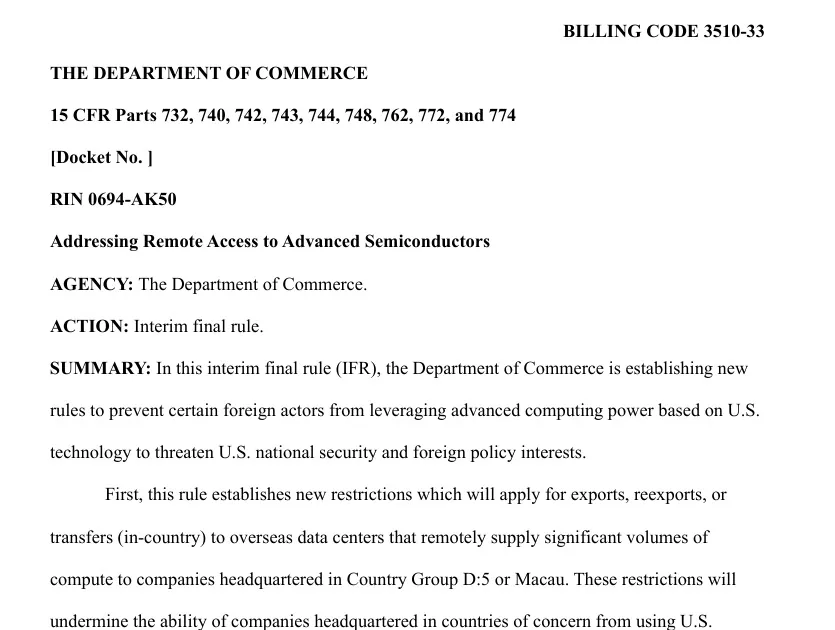
The Commerce Department's interim final rule is titled "Addressing Remote Access to Advanced Semiconductors". Its summary says it aims to stop certain foreign actors from using advanced computing power built on US technology to threaten US national security.
The first part covers overseas data centres that remotely supply large amounts of compute to companies headquartered in Country Group D:5 (a list of restricted countries that includes China) or Macau. Data centres, foundries and chip exporters must do due diligence on their customers, including who owns or controls them.
Which countries now need licences?
On top of existing rules, exporting advanced chips to Indonesia, Malaysia, Singapore, Thailand or Brazil now needs a licence. The rule calls them countries which present a higher-than-normal risk of diversion.
The licence does not apply to chips destined for companies headquartered in the US, provided certain reporting requirements are met. Commerce says it will monitor countries that tolerate evasion and may add import restrictions, new licences or Entity List designations.
How big does a data centre have to be?
The remote-access control applies to data centres that provide access to more than 12,000,000 "aggregate TPP", a measure of chip processing power, to such companies. It counts linked data centres together, including digitally linked ones.
Data centres already providing this must get a licence within 90 days of the effective date. Commercial recommender systems, such as those used by online shops and social media, are exempt.
When does it take effect?
The copy we read on the Commerce site says the rule is effective on the date it is published in the Federal Register, and comments are due 60 days after that. We could not confirm the publication date today. TechCrunch reported the rollout on 16 November 2026.
The rule also formally rescinds the regulations for the Biden-era AI Diffusion Rule, which Commerce says was never enforced.
Why does it matter?
Until now, US export rules mostly covered who buys a chip. This rule also covers who rents the computing power behind it, which was a way around the old rules.
What does it mean for you?
If you use ChatGPT, Gemini or Claude, nothing changes today. The rule is aimed at the supply of chips and data-centre capacity, and it exempts shops and social media recommendation systems.
If you live in Malaysia, Singapore, Indonesia, Thailand or Brazil, the effect is on companies that import advanced chips or run data centres there. It can slow new projects while they apply for licences, which is a reason to watch local data-centre news. US-headquartered firms are exempt if they follow the reporting rules.
It follows our reporting on the [Megaspeed spy story](/news/nvidia-megaspeed-spy-report/) and on [Jensen Huang's resignation as Nvidia's CEO](/news/nvidia-ceo-jensen-huang-resigns/): a government that is tightening how its chips can be reached. TechCrunch links the move to the Megaspeed scandal, though the rule text itself does not name it.
One thing to do now: if you work in a firm that rents GPUs abroad, read the customer-ownership checks in the rule. They apply to the operator, not only the buyer.
What's next?
Watch for the Federal Register notice, which sets the effective date and opens a 60-day comment period. Commerce may also add more countries to the licence list.
Questions people ask
Is the rule already in force?
It takes effect when published in the Federal Register. We could not confirm that date today.
Does it ban chips going to Malaysia?
No. It requires a licence for advanced chips. Chips for companies headquartered in the US are exempt if reporting rules are met.
What is TPP?
It stands for total processing performance, a number the US uses to measure how powerful a chip is. The rule counts the total across a data centre.
What happened to the AI Diffusion Rule?
The new rule formally rescinds it. Commerce says it was never enforced and announced its rescission in May 2025.
Sources
- PrimaryUS Department of Commerce: Addressing Remote Access to Advanced Semiconductors, interim final rule (RIN 0694-AK50)
- CoverageTechCrunch: US tightens AI chip export controls to deter Chinese companies from accessing compute remotely
Why "Confirmed"? We label a story "Confirmed" when the company or government announced it itself. Spotted an error? Email hello@openloopnews.com and we will correct it.