OpenAI's chief scientist proposes shared limits for AI labs, measured by perplexity
On 22 November 2026, OpenAI chief scientist Jakub Pachocki published a post proposing that AI labs track perplexity, a measure of how well a model predicts the next word, and agree common limits on development. Labs would not cross them until understanding and monitoring of AI reaches a set milestone. It is a proposal, not an agreement.
The short version
- 01Jakub Pachocki, OpenAI's chief scientist, proposed on 22 November that AI labs agree common limits on development.
- 02He wants the limits based on perplexity and other measurements, and kept until monitoring of AI behavior reaches a set milestone.
- 03OpenAI published its own perplexity figures to start the discussion, even though it gives competitors a clearer picture.
- 04No limit has been agreed. Pachocki lists problems with perplexity as a shared metric.
At a glance
| Status | Confirmed by OpenAI (post of 22 November 2026) |
|---|---|
| Author | Jakub Pachocki, Chief Scientist at OpenAI |
| The metric | Perplexity: how well a model predicts the next word |
| The proposal | Common limits labs commit not to cross until a monitoring milestone is met |
| His timing warning | AI could speed up pretraining research as soon as 2027 |
| Agreed by other labs | Not stated in the post |
What did OpenAI's chief scientist propose?
Jakub Pachocki wrote that frontier AI developers should jointly set shared norms for evaluating and red-teaming new models, including shared transparency standards. He also proposed common limits that developers commit not to cross.
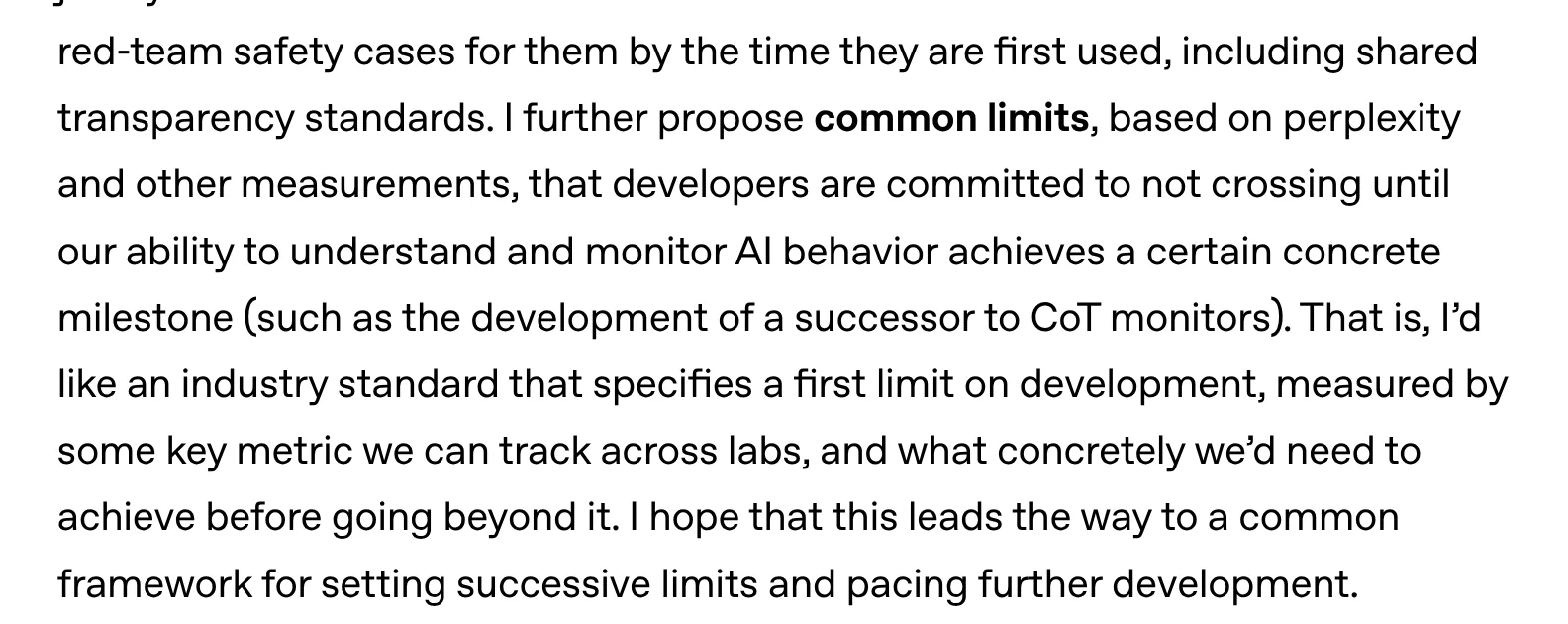
In his words, he wants an industry standard that specifies a first limit on development, measured by a key metric tracked across labs, and what concretely must be achieved before going beyond it.
I further propose common limits, based on perplexity and other measurements, that developers are committed to not crossing until our ability to understand and monitor AI behavior achieves a certain concrete milestone.
Jakub Pachocki, OpenAI
What is perplexity?
Perplexity measures how well a model predicts the next token, roughly the next word piece, on average. Lower means better predictions. OpenAI reports the log of it, also called cross-entropy loss.
Pachocki says the number tracks big jumps. GPT-3.5, at about 0.99, could hold a fluent conversation. GPT-4, at about 0.91, was good at step-by-step reasoning. Below 0.8, he says, transformative abilities appeared in cybersecurity and mathematics.
Why now?
He says a model at about 0.76 started producing groundbreaking results on open maths problems OpenAI had posed for more than a year. He argues a similar burst could hit AI research itself, as soon as 2027.
He expects further transformative abilities near 0.68 to 0.7, and says he does not know what they will be. He also expects current ways of auditing AI alignment to get less reliable.
What are the problems with the idea?
Pachocki lists four. Labs use different datasets, so numbers are hard to compare. Perplexity is not tied to a task people care about. It misses gains from step-by-step reasoning. And nobody knows its floor.
He also says publishing OpenAI's figures took some thought, because it shows competitors where OpenAI stands. He decided the urgency of shared safety measures outweighed that.
Why does it matter?
A top scientist at a leading lab is asking rivals to agree limits, and has published a number to back it. He points to maths results from OpenAI's models; our report on the [claimed Navier-Stokes proof](/news/navier-stokes-blowup-claim-buckmaster-alpoge-ai/) covers a related one.
What does it mean for you?
Nothing changes in your apps today. This is a proposal in a blog post, and no lab, government or standards body has adopted it.
It does tell you how OpenAI frames the next stage. It says its own models are improving fast, that AI is starting to help build AI, and that safety checks may not keep pace. That is OpenAI's view, and no outside group has checked these claims here.
Compare it with our story on [OpenAI's GPT-6.2 models](/news/openai-gpt-6-2-astra-sol/): that was a product launch. This is a call to slow or pace future ones. The two sit side by side.
One thing to do now: watch whether Anthropic, Google or others answer with their own numbers. A shared metric only works if rivals publish it too.
What's next?
Pachocki hopes this leads to a common framework for setting successive limits. The post names no date, no group to run it and no commitment from other labs.
Questions people ask
Has OpenAI agreed to stop or slow down?
The post proposes shared limits for all frontier developers. It does not announce that OpenAI will pause anything.
Do other AI labs support the idea?
The post does not say. Pachocki hopes to see more transparency about perplexity across the industry.
What does a lower perplexity number mean?
The model is better at predicting what comes next in text. OpenAI says better scores on it tend to bring new abilities.
Why is 2027 mentioned?
Pachocki says that as soon as 2027 AI could bring a burst of basic advances in how models are pretrained.
Sources
Why "Confirmed"? We label a story "Confirmed" when the company or government announced it itself. Spotted an error? Email hello@openloopnews.com and we will correct it.