Meta launches Muse Ember, its smallest model, priced at ten cents per million input tokens
On 9 November 2026, Meta launched Muse Ember, its smallest multimodal model, built for repeat agent work such as coding subtasks, tool calls and document extraction. It costs $0.10 per million input tokens and $0.50 per million output tokens for prompts up to 200,000 tokens. It is available in Muse Code plans and on the Meta Model API.
Updated 11 Nov 2026

The short version
- 01Muse Ember is Meta's smallest multimodal model, launched on 9 November 2026.
- 02It reads text, image, audio and video inputs.
- 03It costs $0.10 per million input tokens and $0.50 per million output tokens, up to 200k input tokens.
- 04Meta says it scores 36 on the Artificial Analysis Intelligence Index, at about $0.13 per task at max reasoning effort.
- 05Meta's own table has it behind Claude Haiku 5.5 on FrontierCode 2.0-AA, 27.2 to 34.9.
At a glance
| Status | Confirmed (Meta's own announcement) |
|---|---|
| Launched | 9 November 2026 |
| Company | Meta |
| Model | Muse Ember |
| Inputs | Text, image, audio and video |
| Price | $0.10 input, $0.50 output per million tokens (up to 200k) |
| Above 200k | $0.30 input, $1.50 output |
| Where | Muse Code plans and Meta Model API |
What is Muse Ember?
Muse Ember is Meta's smallest multimodal model. Meta says it is built for the work agents repeat all day: coding subtasks, tool calls, routing, extraction and long documents.
It accepts text, image, audio and video inputs.

How much does Muse Ember cost?
Meta lists $0.10 per million input tokens and $0.50 per million output tokens for prompts up to 200,000 input tokens. Above that, it is $0.30 and $1.50.
A token is a small piece of text a model reads or writes. Meta says Muse Ember is available in all Muse Code subscription plans and on the Meta Model API.
How does it compare with other small models?
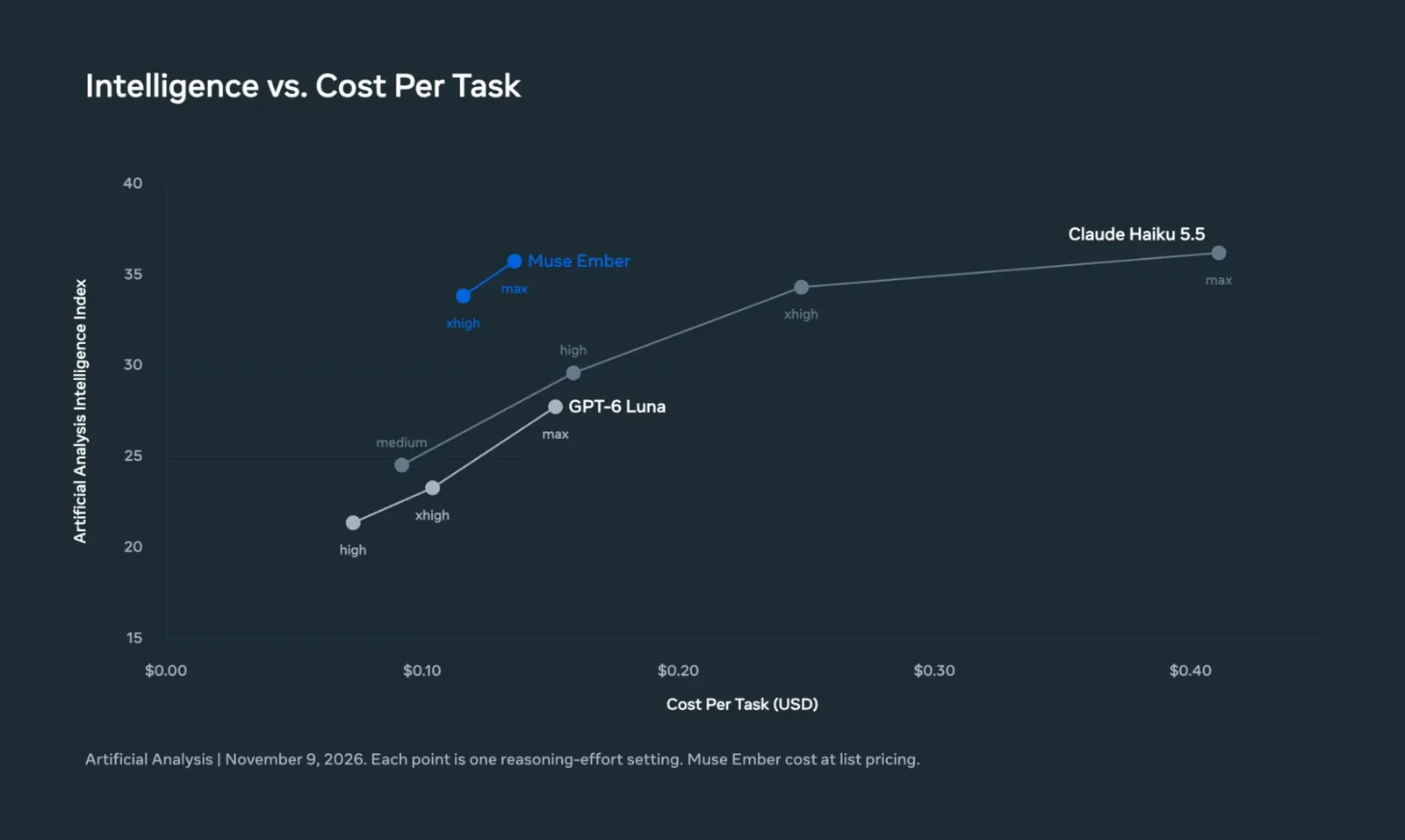
Meta says Muse Ember scores 36 on the Artificial Analysis Intelligence Index, and at max reasoning effort its estimated cost is about $0.13 per Intelligence Index task.
In Meta's own benchmark table, Muse Ember scores 37.8 on AutomationBench-AA against 13.9 for Claude Haiku 5.5 and 20.2 for GPT-6 Luna. On FrontierCode 2.0-AA it scores 27.2, behind Claude Haiku 5.5 at 34.9.
Who is it for?
Mostly developers and companies building agents. Meta says to use it for repeated, bounded work and pair it with Muse Wonder or Muse Spark for planning and orchestration.
Meta quotes testers from Box, Cline, Oracle, Cloudflare and You.com. These are Meta's selected quotes.
What stood out in our testing was speed.
Dane Knecht, CTO, Cloudflare
Why does it matter?
Small, cheap models do the busywork inside AI tools. The lower the price per task, the more agents a company can afford to run.
Most people will not pick Muse Ember themselves. They may use apps that run on models like it.
What does it mean for you?
Most people will never pick Muse Ember. It is a small, cheap model for developers and companies, and you may meet it only through an app that runs on a model like it. If you do not build with AI, you can ignore it.
If you do, the price is the draw: $0.10 per million input tokens and $0.50 per million output tokens for prompts up to 200,000 input tokens. The scores are Meta's own table. It beats Claude Haiku 5.5 on AutomationBench-AA and trails it on FrontierCode 2.0-AA, so the winner depends on your task. We covered [Claude Haiku 5.5](/news/claude-haiku-5-5/) as Anthropic's cheapest and fastest Claude model.
Meta says to pair Muse Ember with a larger model for planning. That is the [Muse Wonder](/news/meta-muse-wonder/) idea: a big model thinks, and a small one does the repeated work.
Do not choose on a vendor table. Run your own repeated task on Muse Ember and one rival, and compare cost and results.
What's next?
Meta says to pair Muse Ember with larger Muse models for deeper planning. It gave no date for further models in this announcement.
Questions people ask
What is Muse Ember?
Meta's smallest multimodal model, built for repeat agent work such as coding subtasks, tool calls and document extraction.
How much does Muse Ember cost?
$0.10 per million input tokens and $0.50 per million output tokens for normal prompts. Past 200,000 input tokens both rates triple, to $0.30 and $1.50, so very long documents cost more.
Where can I use Muse Ember?
It is aimed at developers, so look for it in Muse Code or the Meta Model API rather than in a consumer app. Meta says every Muse Code subscription plan includes it.
Is it better than Claude Haiku 5.5?
It depends on the test. In Meta's own table it scores higher on AutomationBench-AA and lower on FrontierCode 2.0-AA.
What does multimodal mean?
The model can take in more than text. Muse Ember accepts text, images, audio and video.
Sources
Why "Confirmed"? We label a story "Confirmed" when the company or government announced it itself. Spotted an error? Email hello@openloopnews.com and we will correct it.