Google unveils Gemini 4 Argon, its new frontier AI model
Google DeepMind announced Gemini 4 Argon on 30 September 2026: its new frontier AI model, built for long, multi-step work such as coding, legal and finance research, and cyber defence. It can produce up to 1 million output tokens in one go, up from 64,000. Trusted cyber defenders get it first. Paid API customers and Google AI Ultra subscribers come next, at an introductory $2 per million input tokens.
The short version
- 01Gemini 4 Argon is Google DeepMind's new frontier model, built for long, complex work in coding, knowledge work and cyber defence.
- 02Its output limit rises to 1 million tokens, up from the previous 64,000.
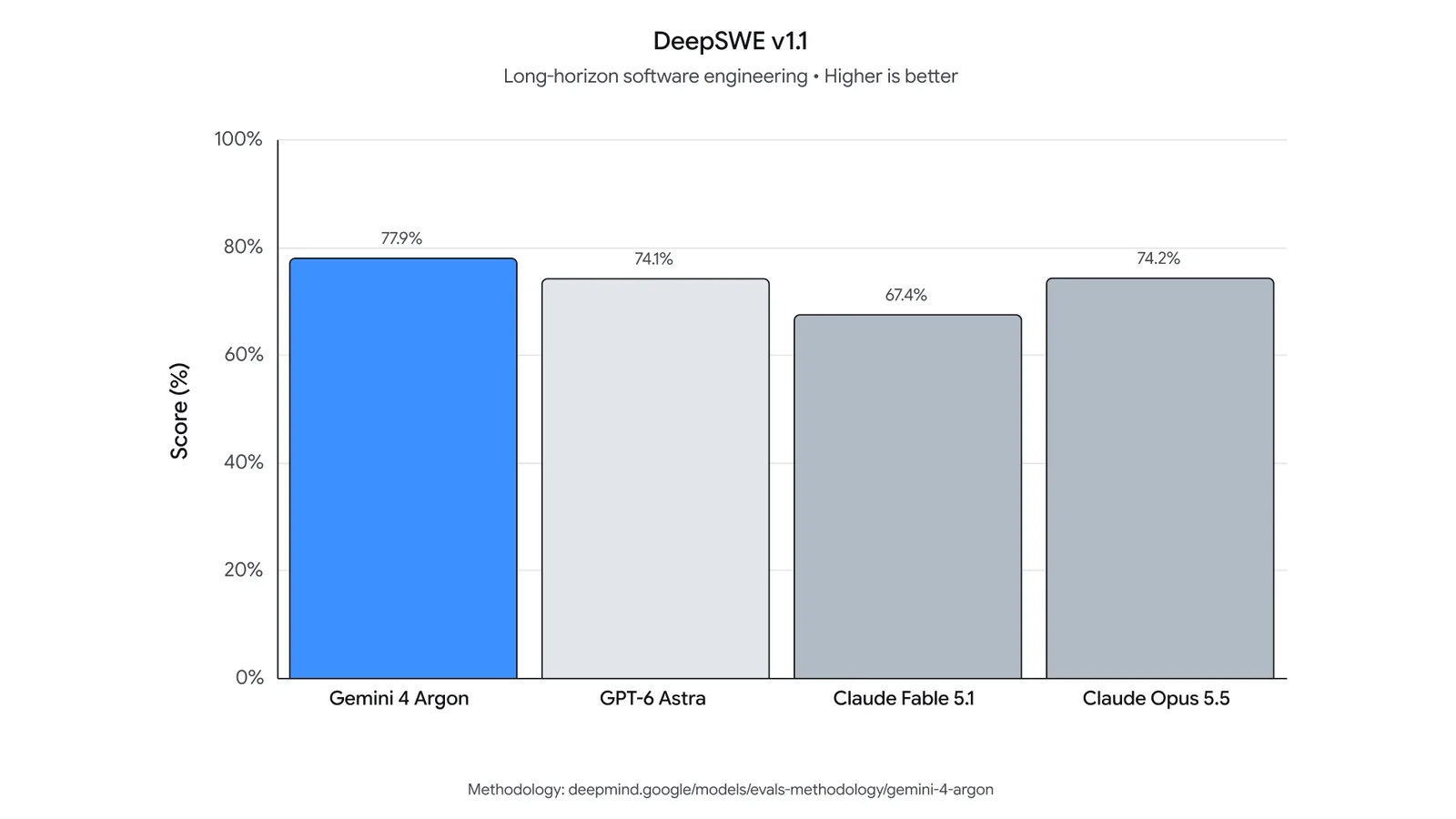
- 03In Google's own tests it leads most of the benchmarks it published, though GPT-6 Astra and Claude Opus 5.5 still win some.
- 04Trusted cyber defenders get it first; paid API customers and Google AI Ultra subscribers are next.
At a glance
| Company | Google DeepMind |
|---|---|
| Announced | 30 September 2026 |
| Built for | Long, multi-step coding, knowledge work and cyber defence |
| Output limit | 1 million tokens, up from 64,000 |
| Available now to | Trusted cyber defenders, through Google's Fairwind Program |
| Next in line | Paid API customers and Google AI Ultra subscribers |
| Launch price | $2 per million input tokens, $10 per million output tokens |
| Price after launch period | $4 per million input tokens, $20 per million output tokens |
What is Gemini 4 Argon?
Gemini 4 Argon is Google DeepMind's new frontier AI model. In Google DeepMind's announcement on 30 September 2026, Koray Kavukcuoglu, SVP of Google DeepMind and Chief AI Architect at Google, wrote that it delivers frontier performance in complex workflows across software engineering, legal and finance work, and cybersecurity defence.
Google is releasing it in stages. It is rolling out first to a set of trusted cyber defenders, and Google says it is taking part in the US government's voluntary process for pre-release model access while it gradually expands access.
What can Gemini 4 Argon do?
Google raised the model's output token limit to 1 million tokens, up from the previous 64,000. That gives the model room to think deeply and produce hundreds of thousands of tokens in a single run, so it can work through hard problems in one go.
Thousands of Googlers already use it for coding, research and writing. Google gives three examples: a team of Argon agents freed over 300 TiB of memory across Google's data centres, Argon agents are moving C and C++ code to Rust in projects of up to 800,000 lines, and it made Google's Rust video decoder, libgav1, 2.7x faster with identical video output.
In one quantum computing task, Google says Argon beat the published baseline by 40% in a matter of minutes.
How does Gemini 4 Argon compare with GPT-6 Astra and Claude?
In the results Google published, Argon scores 77.9% on DeepSWE v1.1, a test of long software engineering tasks, ahead of GPT-6 Astra (74.1%), Claude Opus 5.5 (74.2%) and Claude Fable 5.1 (67.4%). It also leads on the Vals Index (68.9%), AutomationBench (51.3%) and LVBench, a long-video test (91.7%).
It does not win everything. In the same table, GPT-6 Astra leads on FrontierSWE v2 (65.5% to Argon's 55.0%) and OSWorld-2.0 (72.6% to 69.2%), Claude Opus 5.5 leads on Terminal-bench 4.0 (66.4% to 57.4%), and Argon ties GPT-6 Astra on CWE-bench v1 at 68%. These are Google's own results.
Why does Google release it to cyber defenders first?
Google trained Argon to be highly capable at cyber defence: it can find, validate and patch critical software vulnerabilities on its own. Trusted defenders and Google's internal teams get it without cyber guardrails, so they can use its full defensive capability.
Security company Wiz is already using it in its Scan for Good programme, which protects public infrastructure for free. Google says the model found a critical vulnerability exposing sensitive personal information in healthcare software used by hospitals worldwide.
Before a wider release, Google says it is strengthening safeguards in four areas: blocking misuse for cyber or chemical, biological, radiological and nuclear attacks; resisting prompt injection attacks; monitoring the model's reasoning for misalignment; and hardening its test environments.
Safely releasing frontier capabilities at this level requires a phased approach.
Koray Kavukcuoglu, SVP, Google DeepMind
Who can use Gemini 4 Argon, and how much does it cost?
Right now, only trusted cyber defenders in Google's Fairwind Program can use it. Google says paid API customers and Google AI Ultra subscribers come next, followed by developers, enterprises and consumers as soon as possible. It has not given dates.
The introductory price is $2 per million input tokens and $10 per million output tokens, with cached input 95% cheaper. After the introductory period, the price becomes $4 per million input tokens and $20 per million output tokens.
Why does it matter?
Google's most capable model is aimed at long, hard professional jobs rather than quick chat answers. The staged, cyber-first release also shows how carefully labs now hand out their most powerful models.
What's next?
Google says it will keep gathering feedback from early testers and improving its guardrails, then open Argon to paid API customers and Google AI Ultra subscribers first. No date has been announced.
Questions people ask
What is Gemini 4 Argon?
Google DeepMind's new frontier AI model, announced on 30 September 2026 and built for long, multi-step work in coding, legal and finance research, and cyber defence.
Can I use Gemini 4 Argon now?
Only if you are one of the trusted cyber defenders in Google's Fairwind Program. Paid API customers and Google AI Ultra subscribers are next; Google has not given a date.
How much does Gemini 4 Argon cost?
At launch, $2 per million input tokens and $10 per million output tokens, with cached input 95% cheaper. After the introductory period, $4 and $20.
Is Gemini 4 Argon better than GPT-6 Astra and Claude?
In Google's own tests it leads most of the benchmarks Google published, including DeepSWE v1.1 at 77.9%. GPT-6 Astra and Claude Opus 5.5 still lead on some, such as OSWorld-2.0 and Terminal-bench 4.0.
What is Gemini 4 Argon's output token limit?
1 million tokens, up from the previous limit of 64,000.
Sources
Why "Confirmed"? We label a story "Confirmed" when the company or government announced it itself. Spotted an error? Email hello@openloopnews.com and we will correct it.